





They transform tomato farming waste into biodegradable textiles
- Inicio
They transform tomato farming waste into biodegradable textiles
A team of students from ITESO won the Next Gen Leaders league of the Enactus Mexico competition with this initiative, called Trash to Treasure, which promotes the talent of young university students to develop inclusive and sustainable projects.
Diana Alonso
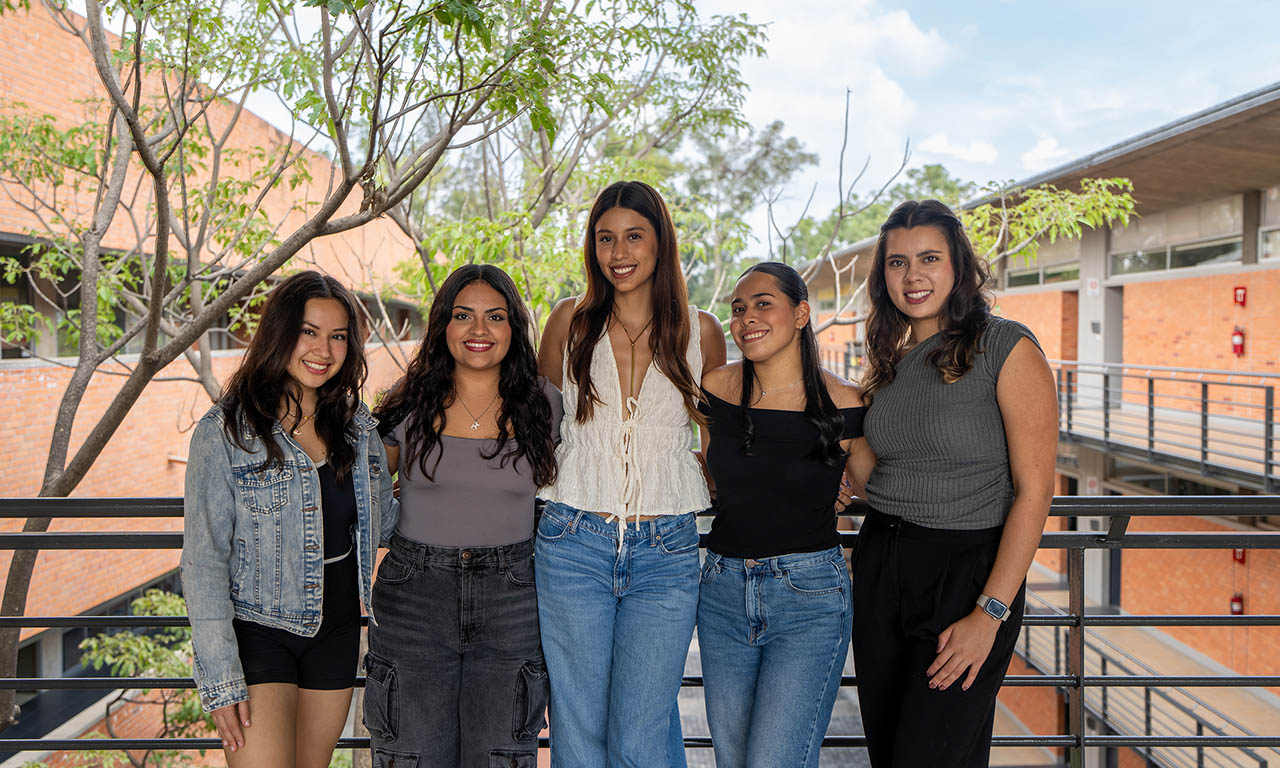
Trash to Treasure, an initiative developed by students from ITESO and the University of Guadalajara (UdeG), was recognized as the winner of the Next Gen Leaders league at the latest edition of the national competition Enactus Mexico. The project stands out for its sustainable approach, linking the agricultural and fashion industries by transforming tomato crop waste into a biodegradable and functional leather-like biomaterial.
The team is made up of ITESO students Azul Sumano, from Biotechnology Engineering ; Hannya Ramírez, from the Bachelor's Degree in Communication Sciences ; Pamela Vargas, from Environmental Engineering and Sustainable Technologies , and Ana Iñiguez, from Commerce and Global Business , and Keila Cardona, from the Bachelor's Degree in Business Engineering from UdeG.
How the tomato leaf became thread
It all began in 2024, when the young women met at the RetODS: High Impact Ideation competition, an initiative promoted by the University-Business Center (CUE) at ITESO. The program seeks to foster and support initiatives that propose solutions aligned with the Sustainable Development Goals (SDGs) established by the United Nations (UN).
While searching for solutions to a problem, the team identified that a significant portion of the waste generated by the agricultural industry came from tomato cultivation, of which Jalisco is the third largest producer nationwide. To delve deeper into the issue, they visited a company in this sector.
“We thought the problem would be in the waste or during production, due to some pest or something similar. Then we realized that it was actually the management of the waste once the crop's life cycle ended,” Vargas mentions.
Companies invest heavily in processing the organic waste generated after the tomato harvest. When this waste is not managed properly, it contaminates the soil and emits greenhouse gases.
The members' first proposal was to use this waste to obtain a textile similar to yarn; with this idea they achieved second place in the RetODS competition, which allowed them to access funding and lay the foundations for an initiative that would continue to evolve.
Enactus and the reactivation of a community
The team learned about the Enactus Mexico competition thanks to Keila Cardona, who is part of the Enactus Hub at the University Center for Economic and Administrative Sciences (CUCEA) of the University of Guadalajara (UdeG). However, to compete, it was necessary to reactivate the Enactus community at ITESO, as it had not participated since 2022.
With the support of Luis Jorge Lépez, a professor at the University-Business Center (CUE) of ITESO, the relationship between the university and the competition organizers was formalized, enabling the university's participation. Following this, the three winning projects from RetODS 2024 were nominated to participate in the national competition, and Trash to Treasure was selected.
The event took place at the Citibanamex Center in Mexico City on July 7th and 8th. The team members, accompanied by Lépez and members of the EmprendeDoor collective, attended conferences, talks, and networking activities.
“More than competing, it was about sharing our projects. It was very interesting to learn about the diversity of proposals that emerged from different universities in the same state,” says Sumano.
Trash to Treasure emerged victorious in the Next Gen Leaders league, which featured nine teams from various universities across the country. “There were also people from other countries like Canada and the United States. Talking with them, we realized we all share the same goal: to continue working towards a better planet,” Vargas explains.
The next step for Trash to Treasure
After working diligently on developing a minimum viable product (MVP), with guidance from professors such as Óscar Rojas, coordinator of the Biotechnology Engineering program at ITESO, and Cristóbal Camarena, a professor in the same program, the team obtained a leather-like biomaterial. This biomaterial was produced through the fermentation of the Pleurotus ostreatus mushroom, using the tomato plant as a culture medium. As a result, the participants have applied to other competitions, such as Start Global in Switzerland and Emerge, a project incubator at CUCEA. They are also determined to advance to a higher level in the Enactus competition next year.